Quick answer
- Start with one regular visit a week from the same person, and an update to you afterwards.
- The Las Vegas summer is the biggest home risk for an older person living alone: plan the AC before May.
- Practical help and hands-on personal care are different jobs; Nevada regulates personal care agencies under NRS Chapter 449B.
- Clark County publishes a free senior directory, the Royal Pages, with meals, rides and support programs.
- Write one local contact list and put it on the fridge.
Signs your parent needs more help
Most warning signs are easy to miss on the phone and obvious in person. If you can't visit, these are the things to ask a neighbour, a friend or someone like me to look at.
- The fridge is nearly empty, or holds the same few things every week.
- Mail is piling up, or bills are going unpaid or getting paid twice.
- Prescriptions run out because nobody collected the refill.
- They have stopped driving, or you are worried that they should.
- Appointments are missed, or they are vague about what the doctor said.
- The house is warmer than it should be, or the AC has been making a noise for weeks.
- Small repairs are ignored, or strangers have been offering to fix things.
- They seem lonely, and a visit has become the highlight of their week.
None of these means your parent can't live at home. Usually they mean the house, the errands and the paperwork have become a bit too much to manage alone.
Practical help or personal care: know the difference
Families mix these up more than anything else, so here it is plainly. Nevada regulates agencies that provide personal care services in the home under Chapter 449B of the Nevada Revised Statutes. Hands-on care such as bathing, dressing, toileting or giving medication belongs with one of those agencies or a medical professional.
Practical help is everything around that: visits, groceries, pharmacy runs, appointments, paperwork and the house. That is the side I do, as one person working on my own. When a family needs both, the two fit together well. The agency handles care, and I handle the errands and the home.
| Practical, non-medical help | Belongs with a care agency or clinician |
|---|---|
| Regular check-in visits and company | Bathing, dressing, grooming, toileting |
| Groceries, errands, prescription pickup | Giving or managing medication |
| Company at appointments | Lifting, transfers and help moving around |
| Mail, bills and paperwork sorted | Nursing or any medical care |
| AC checks, vendors and repairs | Overnight or round-the-clock caregiving |
If your parent has a low income, Clark County Social Service also runs income-based programs, including a Homemaker Home Health Aide program, with a yearly eligibility check. It is worth asking about before paying for everything privately.
Set up a weekly check-in
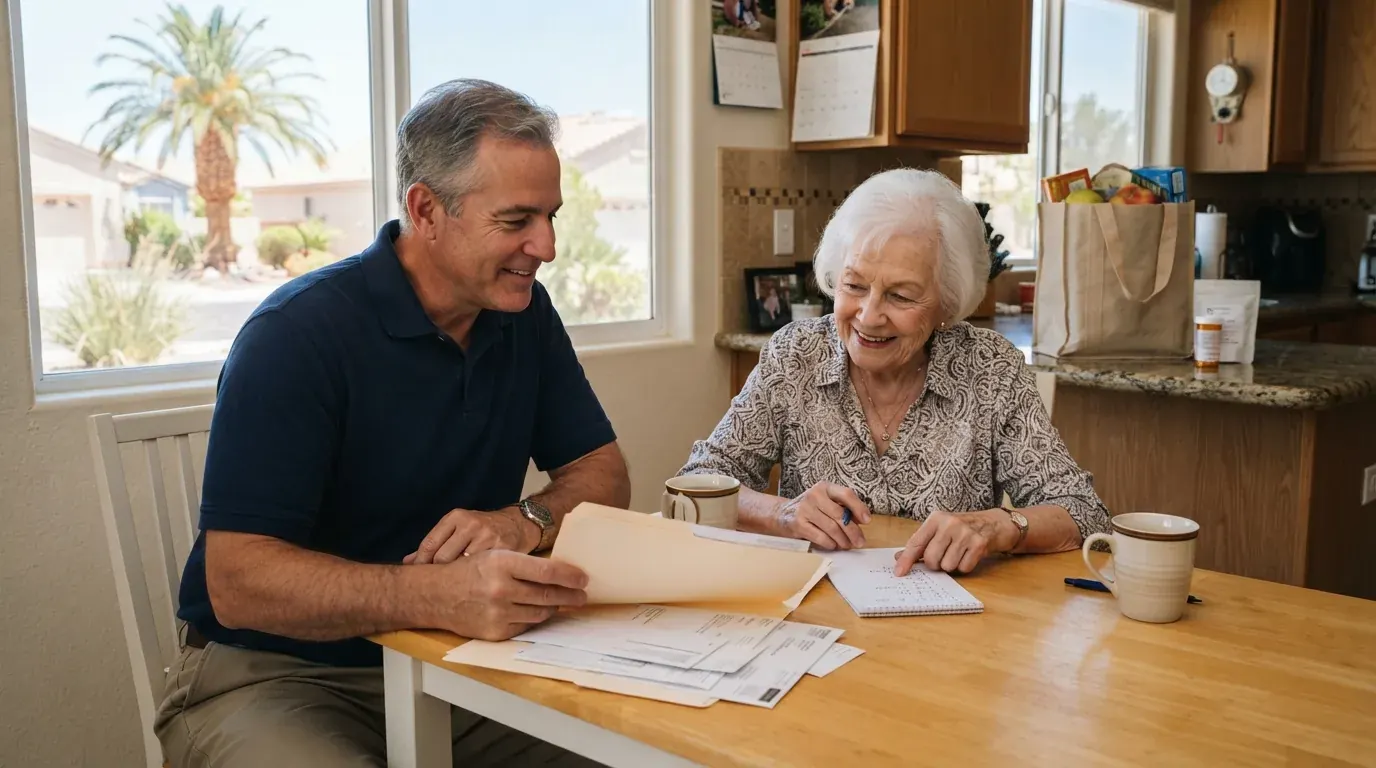
The most useful thing you can arrange from another state is a regular visit from the same person, on the same day, with an update to you afterwards. Your parent gets something to look forward to. You get facts instead of guesses.
On a check-in I look at mood and energy compared with last week, the fridge and pantry, the thermostat, the mail, and anything around the house that needs a repair or a vendor. Photos help a lot: a picture of a letter or a dripping tap saves three phone calls. Agree with your parent what gets shared, so the visits feel like help and not like being watched.

Pick a fixed day and keep it. Older people often plan their week around a visit, and a reliable Tuesday does more good than three random drop-ins.
Groceries, prescriptions and getting around
Groceries can be done from a list, or together if your parent enjoys the outing. Many older people like choosing their own fruit, and the store trip is a good reason to get out of the house before the heat builds.
Refills are collected from the pharmacy your parent already uses. Whoever does the pickup should not be sorting pills; if your parent needs help taking medication correctly, ask the pharmacist about packaging options or bring in a care agency.
For rides, the Royal Pages lists free and low-cost options: Helping Hands of Vegas Valley gives rides to seniors aged 60 and over for medical appointments, groceries and errands, Artie J. Cannon Helping Hands of Henderson does the same for Henderson residents, and the state's Taxi Assistance Program offers discounted taxi coupons to eligible seniors aged 60 and over.
Doctor appointments from a distance
Appointments are where a second person helps most. Someone checks your parent in, waits, makes sure they get home and settled, and, if your parent agrees, writes down the next steps the doctor gave. That note to you is often the only way to find out what was actually said.
Bills, mail and scams
Unopened mail is one of the first things to slip. Sorting it together each week, flagging what is due and setting aside anything that looks like a scam keeps most problems small. You and your siblings decide who pays what.
If you ever suspect abuse, neglect or financial exploitation, Nevada's Aging and Disability Services Division runs Adult Protective Services, which investigates reports involving people aged 60 and over, and takes reports online. Powers of attorney, wills and benefits questions belong with an elder law attorney, not with a helper's best guess.
Keep the house safe in the summer heat
Las Vegas summers regularly reach 110 to 117 degrees, and an older person does not always notice how hot the house has become. An AC failure in July is not an inconvenience; it is dangerous.
- Have the AC serviced every spring, before the busy season, and keep the company's details on the fridge.
- Check the thermostat on every visit. A simple model your parent can use beats a smart one they never touch.
- Agree a plan for a breakdown: who calls the repair company and where your parent goes to stay cool.
- Change filters on schedule and keep spares in the house.
- On the hottest days, add a quick call or text on top of the weekly visit.
Monsoon season, July to September, brings sudden storms. After a big one, look for roof leaks and water at the doors, and be wary of anyone knocking with a same-day repair offer.
Build one local contact list
When something happens you need names in one place, not scattered across old texts. Write a single list, give a copy to your parent and everyone on it, and stick it on the fridge.
- One local person who can get there quickly, and a backup.
- A neighbour with a key who knows your parent.
- Doctors and the pharmacy.
- The AC company, a plumber and an electrician.
- The HOA office or guard gate, so visitors and vendors get in.
- Any agency or care manager already involved.
- You and your siblings, and who decides what.
When to bring in an agency or a care manager
Practical help goes a long way, but it has limits. Talk to your parent's doctor, a home care agency or a professional care manager if your parent needs help bathing, dressing or getting out of a chair, if medication is being missed or mixed up, after falls or a hospital stay, or if memory problems make it unsafe to be alone for long. A care manager can assess the whole picture; practical help can keep running alongside.
Ask for the Royal Pages. It is Clark County's free directory of senior services, from meals to rides to support groups, and it saves hours of searching.
Questions
Can someone check on my parent in Las Vegas if I live in another state?
Yes. A regular visit from the same person, with an update to you after each one, is the simplest place to start. I do exactly that for many families.
Who helps with bathing, dressing or medication?
A home care agency or a medical professional. Nevada regulates personal care agencies under NRS Chapter 449B. Practical helpers like me handle the errands, appointments, paperwork and house.
Are there free rides for seniors in Las Vegas?
Clark County's Royal Pages lists Helping Hands of Vegas Valley and Artie J. Cannon Helping Hands of Henderson, which give rides to seniors aged 60 and over. Ask each about eligibility.
Who do I contact if I think my parent is being exploited?
Adult Protective Services, part of Nevada's Aging and Disability Services Division. Call emergency services first if anyone is in immediate danger.
How do I start?
Write down what worries you most, then arrange one weekly visit and see what it shows. Tell me what you need and I'll call you back.